

 Apple Podcasts

 Spotify

 Pandora

 Castro

 iHeartRadio

 Amazon Music

 RSS Feed

 YouTube
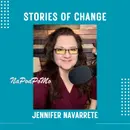
Start Before You’re Ready: Jennifer Navarrete on Podcasting and NaPodPoMo
Have you ever had an idea you wanted to try, but kept putting it off?
Maybe you weren't sure how it would turn out. Or maybe you thought you needed a better plan before getting started. I can relate.
Jennifer Navarrete has another approach: give yourself permission to experiment.
Jennifer is the founder of National Podcast Post Month, or NaPodPoMo, a November challenge to create and publish 30 podcast episodes.
Back in 2007, Jennifer went looking for a podcasting challenge. When she couldn't find one, she decided to start it herself. With just three days to prepare, she invited her community to join her. Fifty podcasters participated that first year.
During our conversation, Jennifer shares how that simple experiment grew into an ongoing creative challenge.
I'm taking on the 30-episode challenge myself this November, so I was especially interested in Jennifer's advice about planning and trying new approaches.
Questions We Explore
What is NaPodPoMo, and do you have to publish an episode every day?
Jennifer explains that the goal is to publish 30 episodes by November 30. You can prepare ahead, experiment with formats, and find an approach that works for you. (I'm not sure I'll publish every day - but we'll see.)
How do you come up with enough ideas for 30 episodes?
Jennifer suggests organizing a broad subject into weekly themes, using introductions, shorter conversations, and recaps to give the month some structure.
What if you're afraid your idea won't work?
Treat it as an experiment. Give yourself a defined period to try something, learn from it, and decide what you'd like to do next.
About Jennifer
Jennifer Navarrete began podcasting in 2005 and founded National Podcast Post Month in 2007. She's also the founder of Brewing Media.
Listen and Connect
National Podcast Post Month: https://napodpomo.org
Stories of Change: Helping You Navigate What’s Next
Hosted by Judy Oskam
Navigating a change or wondering what comes next?
Hear real stories from people who have faced unexpected turns, made important choices, and figured things out along the way.
A little wisdom to help you find your own way forward.
Explore more at StoriesofChangePodcast.com.
00:00 - Starting Before You Feel Ready
00:52 - The Origin Of NaPodPoMo
02:59 - Podcasting Without Gatekeepers
08:19 - Community Magic And The Mega Feed
12:17 - A Simple Framework For 30 Days
16:23 - Perfectionism Versus Experimentation
19:11 - Why Your Voice Still Matters
20:11 - The Question To Take With You
Starting Before You Feel Ready
Judy OskamWell, have you ever thought about starting a podcast or trying something new with the podcast? You already have. I know I have, but you've stopped. Maybe you just didn't think you could do it. Well, sometimes the best way to discover what you want is simply to begin. I'm Judy Oskam, and this is Stories of Change, helping you navigate what's next. Today I'm talking with Jennifer Navarette, the founder of National Podcast Post Month. The challenge invites podcasters to create and publish 30 episodes in 30 days. But this conversation isn't only about producing more episodes, it's about what can happen when we give ourselves permission to experiment, to learn as we go, and really to share what our message is. Jennifer, welcome to Stories of Change. Let's start at the beginning.
The Origin Of NaPodPoMo
Judy OskamHow did you get started with this 30-day challenge deal?
Jennifer NavarreteYou know, I started podcasting in 2005 and it was very early adopter geeky kind of a thing. And in 2007, I heard about NanoRimo, National Novel Writers Month. And I was like, wow, 50,000 words in the month of November. Kudos to those folks. That's not me, but cool. And then I heard about Nab Blo Pomo, National Blog Post Month, 30 blog posts in 30 days. And I was like, oh. And then I heard about Nav Vlow Pomo, which was vlogging at the time. Um, they were doing 30 videos in 30 days. I was like, oh, okay, okay, hello, clue that uh November is the month that you do these 30-day challenges. Let me go join the for podcasting. And when I went to go join one, there wasn't anything to join. And I sat there going, even the video bloggers have a 30-day challenge and the podcasters don't. Well, that can't be right. So three days before, I sent out an email to my community and just said, hey, I'm doing this 30-day challenge. Join me. You know, I don't know what's going to happen. Let's let's give it a whirl. And that first year, 50 podcasters joined, which was just blew me away. Sure. Um, and here we are, you know, approaching year 19 in November of 2026. And, you know, it it's it's a challenge that finds you when you need to be found for the reason you need to be found because it isn't anything except what you need it to be. And I think that's the beauty of a challenge like this is that it's not, it's not a necessarily like a formulaic. It's just uh it's a space for you to be creative. And that's what you said. How would you like to be, you know, what if you could be creative in this way? And and I think that's the beauty of it is it allows brand new podcasters, never done it before, they're they're dipping their toe into the podcasting stream, and they're like, okay, I'm gonna give this a try. And they're gonna, they're gonna learn fast. And then seasoned podcasters like like myself and yourself, we we know how to podcast. This is not new to us, but we have something we've always been curious about, whether it's a concept, a show idea, or even technology, or a new way of doing things. And it's it's a safe community space, whether you're new or whether you're seasoned, to try new things.
Podcasting Without Gatekeepers
Judy OskamI love that. And you were such an early adopter, like you said. You were the trendsetter way back when starting, and I've been following your career for a long time and all of your podcast challenges and your media company. Um, what does podcasting allow you to do? Because I'm all about purpose and telling the story and having a platform. What why did you get into this in the first place?
Jennifer NavarreteUm, in July of 20, 2005, I heard about podcasting for the first time when Apple uh said that iTunes now had podcasts. And I was like, podcasting, what the heck is that? So I I'm always been curious by nature. And so I did a deep dive and doing a deep dive back then, there wasn't much. Yes. Adam Curry was the podfather, the co-founder of podcasting, along with Dave Weiner, and he had the daily source code, and that was kind of like the source of truth because he was making, you know, building in public and inviting us along on the journey. And so in I told my sister about it, and in September of 2005, we launched the Morning Brewcast, and it was just the two of us drinking coffee, talking about coffee. And what hit me was about podcasting was that I realized that you mean I can record something, put it up on the web, and no one can stop me. And I was like, sign me up. I mean, it was so liberating because if we go back in time, if you wanted to be seen, like on television or in the movies, right, you needed to be on television and movies, but now you could have a vlog. If you want it to be heard, you need it to be on the radio, right? And but no, you could have a podcast. And if you wanted to be read, you need it to be in the newspaper or a magazine, but now you could write your own blog. And so that was revolutionary. That it was like the democratization of media, where you didn't, there were no gatekeepers. And if you needed anybody's permission, you just needed to go look in the mirror and give it to yourself. So that whole concepting of freedom and that I could go out and just record and put it out there. And I didn't need to ask anybody's permission. I didn't need to have qualifications, certifications, I could just do it, was so refreshing that I was like all in. And so in that same September, I launched the San Antonio Meetup Group. And that kind of started this whole journey where then in 2007, May of 2007, um, we did the very first podcast conference in Texas, which was, you know, podcamp San Antonio, which is a user-generated conference. And, you know, this thing just kept rippling and rippling. And I was discovering so many folks like myself, because when you hold space for people, all of a sudden, people who are also doing what you're doing, but in their own area of the world or in the own area of the state, we can get together and in that way we grow. And so the whole concept thing of learn, share, grow, which social media club came up with back with Chris Hewer and Christy Wells, um, that really struck me because I love the idea of learning something new, sharing it with others, and then all of us growing together. That's still my motto to this day. I still believe that. I'm very early adopter geeky going, ooh, have you heard about that? Let's go see what it is. And it's like, oh, this is cool. This is for this purpose, or eh, not for me, or maybe not for you, but here's who it is for. I that's still me to this day. I love going and seeing the new things and then sharing it, and then hopefully that we grow in some capacity altogether.
Judy OskamBecause it has really changed the whole media landscape. And we we teach this in our classes at Texas State, and you don't need the gatekeeper anymore. And when I started back in the business before you, there was always a gatekeeper. And the fact that you then can have, we can have our own voice with our own message and our own purpose. That to me is also what attracted me to podcasting too. And and, you know, the opportunity to really reach an audience or not, but just to really get your platform out there, get your message out there.
Jennifer NavarreteYou know, that whole um I'm a big believer in that we all have a mission and message to share with the world. And we're not for everybody. Like you kind of mentioned that yes or maybe not. I think that's great. I think if we put our mission and message out there, we're going to attract the people who are who want to hear that, who want to lean in. We may also repel the folks who are like, that's not for me. That's great. That's absolutely wonderful. If you hear what I have to say and you're like, that's not me, and you go 180, thank you so, so much. And then the other folks who are go, hey, that's interesting to me, and they lean in, fantastic. It's wonderful. I think a lot of times we feel that we have to appeal to everyone, but actually, no. And in a medium like this, where it's very intimate, where folks jam those earbuds in and they're you're whispering in their ears, and people set their habits by you. I mean, I myself know that every Friday around lunchtime, that podcasting 2.0 comes out. And so I'm waiting for that to hit and I'm checking in the afternoon. I know that these shows come out, you know, all these different shows come out at a certain day on a certain time, and I've set my week to that. I have developed a habit around those shows. And that's the beauty of these this kind of medium, is that the right fit clients, the right fit listeners, the right audience will set their habits around you and you become an integral part of their just normal life. And it's kind of that wonderfulness, because you may not know everybody who listens to you, but there will be folks who will come in and say, hey, I heard this episode or boy, I really like this. And that's always gratifying to hear that. But how many folks don't and yet are still as keenly attuned and still jamming those earbuds in?
Judy OskamI know. I I yeah, that and such a good opportunity to share a message or to share some kind of information that someone might be able to learn and grow from. That's what I'm always about too. Well, back to the the November challenge. Can you
Community Magic And The Mega Feed
Judy Oskamtalk a little bit more about how that got started a little bit and why you why you jumped into that so so long ago?
Jennifer NavarreteYou know, it's kind of, it's I it's this is year 19. So, you know, I I when I did that first year, I could not have foreseen that this would still be going strong, but there must be a reason why it is still going strong. Number one, I'm still as excited about it as I was back then. Number two, there's a cohort of people who come back almost every year. There's folks who have been here and have gotten what they needed and have gone and done other things, which is great. And there's folks who kind of come back in as they go, and then folks who discover it for the first time. And again, I think just by holding space and allowing people to come as they are when they're ready for it, whether they're seasoned or whether they're new, whether they want to come and go or whether they return every year, I think that's the real beauty of it. And NAT Pod pomo is not thousands of people who join every year. It is a small cohort. I mean, 30 podcasts in 30 days, that's a big commitment. It is a big commitment. You really have to, it's huge, right? So not it's not gonna be for everyone every time, but for the folks who join, you know, we have this thing called the mega feed, which I gather everybody's individual RSS feeds and make it into one, the nappod pomo of that year. And so you can subscribe to that single feed of everyone's shows, and you can click play, and you have no idea what you're gonna hear because it's just as people are dropping episodes, it's what happens. And the real serendipity and discovery there is beautiful because I've heard podcasts that if I had had the choice to look at them and click play, I probably wouldn't have clicked play. Not because I did anything about that person, just that the topic wouldn't have per se been something that I would naturally have leaned into. But then after hearing it, I was like, oh, I'm so much more aware of this topic. I'm so much more knowledgeable, and it's actually been very beneficial. So I think that's one of the kind of the little magic pieces of this. Why I keep coming back every year is because I get folks who, you know, tell me the things that they have accomplished in their own lives because of napod Pomo. And I really think it hasn't have really doesn't have anything to do with Napod Pomo per se. It was them giving themselves permission to do the thing that was tapping them on the shoulder because that's what it is. You've got something tapping you on the shoulder, it's an idea, it won't leave you alone. You're like, I don't have time for it. I've got a lot of stuff going on, it's gonna take too much this, you know. I'm gonna look at my schedule, look at my calendar, but yet it persists, right? There's this idea that just keeps tapping you on the shoulder. And I feel like it's like a spark. And when you have a spark like that that won't leave you alone, you need to give it oxygen. And two things will happen. If you give it oxygen, it'll either fan the flames, or if you give it oxygen, it'll snuff it out. But it will stop tapping you on the shoulder once you know what it is. And sometimes just doing it satisfies, if it was just a curiosity, it satisfies it. And and I have done challenges where I was like, oh, I'm really excited about it. And then I was like, two weeks in, I was like, meh. Yeah. Well, at least now I know. And that's it. I'm giving myself permission to play without needing to feel like it has to be whatever that the world thinks. It's just me going, I don't know about this. I'm gonna put my podcasting lab coat on, get into the lab, and experiment. I have no idea what's gonna happen. You can join me on that journey. Let's see.
Judy OskamWell, and that's exactly that's the take that I'm going to jump into. I and I'm calling it an experiment. I'm doing my 30-day experiment, and I'm gonna post about this and talk about this to my audience and really try and jump on this bandwagon if I can. I've I've followed this before. I've gone to your San Antonio podcamp years ago. I just went one, I could just go one time. Uh, but I've I've always wanted to do this. So, what advice would you have for someone when they're looking at getting their messaging out in a 30-day format? Because there are ways to structure this, I think, that you have found that worked a mix of solo interviews, a solo segments, a mix of interview segments, some relaunches. What's your idea for a mix to help someone like me kind of uh attempt this challenge?
Jennifer NavarreteSure. You
A Simple Framework For 30 Days
Jennifer Navarreteknow, I actually developed a framework over the years, and it's I call it the Napod Pomo 30 Day Challenge Framework. And what it is is that you think of the 30 days and you break it down by weeks. And you think, okay, I have this big topic, and now I'm gonna break it down into these little four subtopics. And then each of those, that subtopic has, you know, days in between where you, you know, you're taking people, you're breadcrumbing the story or whatever the mission and message that you have. So think of it this way on day one on November one, you introduce yourself, tell everybody what the show is about, what they can expect, and what your topic is going to be over the next month. And then on day two, you introduce that that topic for that week. And so for the first for the next five days, that day two through six, you're doing those five segments, five days of five episodes. And then on the seventh day, you're gonna recap that entire week. And then you tell them at the very end, and so next week we're gonna be talking about this, you know, in the next episode. And so then the next day eight comes around, and you say, Hey, this is what we're talking about this week, and this is what we're gonna do. And then you take that time. And so then on again, on the seventh day of that second week, then you're gonna do the same thing. You're gonna recap what you talked about and then talk about what the next thing is. It's a little formulaic, but sometimes you need that formula in order to get out of your own way because we have so many ideas and so many directions we could go, and what should we do? And we overwhelm ourselves when really it can be very, very simple. Take your big topic, break it down, and then tell people what you're gonna tell them. Tell them, tell them what you told them, and just keep doing that. Now, on day 28, you're finishing that four-week, you know, uh content. On day 29, you're gonna recap the month. Here's what we talked about this entire month. Here's the do the big takeaways for the whole thing. On day 30, what you're going to do is you are going to then tell folks what's next. And if it's a one and done and you're doing it, then you can say, here's where you can find everything. Here's all the things that I spoke about, here's all the links, here's all the resources, here's where else you can find me doing these other things. But it could be that you're like, we're good, that I'm gonna consider that season one. And now we're gonna take a little bit of a break because after a 30-day challenge, I'm gonna tell you you need a break. A small break. And then you and then you say, and we'll do season two, you know, in January or in December or whenever you want to do it. So it gives you permission to experiment without the pressure, the undue pressure of feeling like I've got a podcast from now until forever. Yes. Because it's a challenge, it's it's got a starting, it's got an end. And you get to decide what happens in between, and you get to decide what happens next. And it's all up to you. And so I think that open experimentation that everyone else that's participating is doing their version of their experiment is kind of liberating.
Judy OskamSure. I I I love that. And from a from a teaching standpoint, what a great way to teach, you know, and to share information because you're going to, you know, preface it with here's what's coming, here's the content, and then here's the review, here's your exam, if you will, and then you're gonna move on. So, really, that's a really good, strong method. And have you seen people that have gone on from that and then continued to do daily and keep going?
Jennifer NavarreteUm, some folks have done daily for a little while. I don't know if I've uh seen anybody do daily for a full year. You know what, maybe one person did. But just this past year, one person uh who had participated many years, it was actually Mike Dell, who's uh with Blueberry. He said, You know, I've really enjoyed doing these dailies and I'm gonna keep doing it. And he did it for a while, a few months, I want to say. I don't know if he's still doing daily. I haven't looked recently. I have to check in with him. But there are folks who have written books based off of their 30-day challenge because they realized, oh, yo, there's actually something more here. Yes, there's something there, and it's a book. Other folks have launched new business, new businesses. Others have just thought this is actually a fun idea for an ongoing podcast, and they've kept it going. And they weren't planning to, they were just doing it to satisfy curiosity or just as a challenge because they already had a podcast, but then they realized they like the formula or the kind of like the nugget aspect of this podcast. And so they thought, this has legs, and they've continued it. So I think it will be whatever it needs to be for you, and it doesn't have to be anything more. It can be those episodes, and that's it. Walk away, pat yourself on the back. You've successfully completed the challenge, and that's it. Walk away.
Perfectionism Versus Experimentation
Judy OskamYeah, but why is it so hard for us to give ourselves permission to kind of live in that experimental landscape, if you will?
Jennifer NavarreteUm, I think it has to do with the fact that we are professionals in our industry at a certain and and for young folks, they're probably a little bit more willing to experiment because they don't know it. But for those of us who are seasoned and are experts in our field, we have this um thought that what are people gonna think? Or there's a structure there already.
Judy OskamSo yeah, right.
Jennifer NavarreteThey already know I do this, and if I do this, and it what if it doesn't work out? Yeah, it's an experiment, right? We're putting our lab coat on. We don't know what's gonna happen. And I think by framing it as an experiment, not just to yourself, but to the world at large, it takes the pressure off of us to feel like we have to be perfect. We can't make mistakes, we can't falter. No, you absolutely can because we're in a lab. We've got no idea what's gonna happen. What you thought was gonna happen on day one, by day 20, you're like, well, that wasn't what happened at all. But I'm pleasantly surprised. Or, you know, this was not exactly what I thought. You there's no failure, it's lessons learned. You're wiser for it, you're richer for it, and and it winds up being something that you wind up gaining from, regardless of the fact that maybe your your your you know, your theory of what was gonna happen doesn't happen the way you thought it was, but then you go to the end, you're like, well, that wasn't terrible. It wasn't what I thought, but here's what I gained out of it. So I think it's that we have this external pressure and and internal pressure of that we need to be on the mark and we can't falter or we can't, you know, do something that's not perfect. And the reality is, how are you going to grow? I mean, if you think about a seed in the ground, it's a beautiful, perfect seed, but in order for it to grow and bear fruit, it's got to break out of its shell, it's got to break through the ground, it's got to do all of these things in order to actually fulfill its mission, right? To, you know, what is it gonna do? You know, what are we gonna do with this one precious life? Well, I say give it a oh, build in public, experiment and build okay with it. I like that.
Judy OskamYeah, I like that. Yeah, build in public. That's great. Well, I know, I know when I started my podcast, I worked with uh an undergraduate student, uh Ann Cox, and she she was working with me on this. And I would, I would go back and forth with her, and she just she would just say, just do it. Why don't you just do it? You can always change it. And I said, Why am I not thinking like that? You know, why don't I think more like that? But I think it's exactly what you say. We get stuck in our our shoulds, and you know, this is the way it's always been, and this is what the we we perceive is the issue of I don't know what, I don't know what, but I mean, if it weren't for that undergraduate student to just finally push me over the edge, and it was it's just been a joy to podcasting is so much fun, and I think I think more and more people should, you know, you know now nowadays you could say everyone's got a podcast, but still there's a lot of room.
Why Your Voice Still Matters
Judy OskamIs the podcasting industry saturated, oversaturated? What's your thought on that?
Jennifer NavarreteUm, I saw a post recently on LinkedIn where someone was talking about this exact topic, and I was like, there's so many books that are already written. Why would you write a book? Yes, you know, there's so many blogs that are out there. Why would you blog? There's so many, there's so much music out there, why would you make music? It's like, no. Yeah, so so the thing is that all of us who are you and I could blog podcast about the exact same topic, and it would be radically different because we have different lived experiences, we have different understanding, we have a different thought process, we have a different everything. And so a lot of times where you see, like, oh, well, somebody's already doing that. It's not you who's doing that, though. No one has your unique spice and flavor. No one. So why wouldn't you want to get it out there to the world? Especially again, if it's just tapping you on the shoulder and just keeps bothering you, you know, keeps coming back going, you know, it'd be a really great idea. And like, no, no, no, no, I don't have time for that. Give it some oxygen, see what happens. And that's what you can do during Napod POMO.
The Question To Take With You
Judy OskamWell, what's that idea that keeps tapping you on the shoulder? Jennifer gives us a way to explore it. Set aside some time, give yourself permission to experiment and then see what you learn. For me, that means trying this 30-day podcast challenge. For you, it might mean something completely different. What's one thing you could begin without knowing exactly how it will turn out? Jennifer, thanks for the encouragement and for creating a space where people can try. I'm Judy Oskam. Thanks for listening to Stories of Change, helping you navigate what's next.