

 Apple Podcasts

 Spotify

 Pandora

 Castro

 iHeartRadio

 Amazon Music

 RSS Feed

 YouTube
Behavior Design: Turning Ideas Into Action with Stephanie Weldy
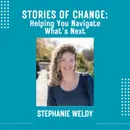
Have you ever had a great idea but got stuck on what to do first? Maybe you’re building a product or making a change at home. You know what you want. The first step is harder to pin down.
In the first of two episodes, I talk with Stephanie Weldy about how behavior design can help. Stephanie is a certified Tiny Habits® coach who works with Dr. BJ Fogg, author of Tiny Habits: The Small Changes that Change Everything. She explains how getting specific about what you want someone to do can change the way you approach a problem.
Questions We Explore
What’s the difference between an aspiration and a behavior?
An aspiration is what you want to achieve. A behavior is a specific action you or someone else can take to move toward it.
How can brainstorming help you decide where to start?
Stephanie describes an approach called “magic wanding.” Give yourself room to list several things that could help, then look at which ones fit the person and the situation.
Why start with a tiny version of a new habit?
A small action can be easier to fit into something you already do. Stephanie also talks about taking a moment to recognize that you followed through.
One Idea to Take With You
Pick one goal you care about and write down a few actions that could move you toward it. Choose one that feels doable. What’s the smallest version you could try right after something you already do?
About the Guest
Stephanie Weldy, M.Ed., works with BJ Fogg to teach innovators how to apply behavior design to products and services that support health and well-being. She previously led wellness programs in higher education, nonprofit, and government settings and is a certified Wellcoach and Tiny Habits® coach.
About the Guest
Stephanie Weldy, M.Ed., is an expert at the intersection of Behavior Design and employee well-being. She works with BJ Fogg, PhD, Stanford Behavior Scientist and NYT bestselling author of Tiny Habits, to teach industry innovators how to use Behavior Design in the products and services they are building to help people be healthier and happier.
Stephanie previously led comprehensive wellness programs in higher education, non-profit, and government settings. Stephanie practices what she teaches daily as a working parent to two tiny humans (ages 5 and 7).
She has a master's degree in Education in Community Health and is a certified Wellcoach and Tiny Habits® coach.
Listen and Connect
Continue with Part 2 for ways to apply behavior design to friendships, everyday routines, and work.
Stories of Change: Helping You Navigate What’s Next
Hosted by Judy Oskam
Navigating a change or wondering what comes next? Hear real stories from people who have faced unexpected turns, made important choices, and figured things out along the way.
A little wisdom to help you find your own way forward.
Explore more at StoriesofChangePodcast.com.
00:00 - Welcome And Meet Stephanie Weldy
00:46 - Why Aspirations Do Not Change Behavior
02:04 - Fogg Maxim 1
03:55 - Matching The Right Behavior To Context
06:05 - Magic Wanding To Find Better Options
10:18 - Change Together At Home And Work
13:10 - Tiny Habits Over New Year Willpower
19:33 - Celebration And The Emotion That Builds Habits
Welcome And Meet Stephanie Weldy
Judy OskamHave you ever had a great idea but struggled to get other people on board? Or maybe you're developing a new product, starting a new business, or trying to introduce a better way of doing something? Well, I'm Judy Oskam, and welcome to Stories of Change, Helping You Navigate What's Next. Today I'm talking with Stephanie Weldy, a behavior design expert and certified coach. She works with Dr. B.J. Fogg, author of the New York Times best-selling book, Tiny Habits, The Small Changes That Change Everything. Stephanie helps innovators use behavior design to create products and services that work. Welcome, Stephanie. Thanks for joining me.
Stephanie WeldyThank you, Judy. I'm so glad to be here.
Why Aspirations Do Not Change Behavior
Judy OskamIt's going to be fun. Well, I wanted to start with uh what's the biggest challenge that innovators face when they're trying to get people to change their behavior? What do you see happen first?
Stephanie WeldyYeah, I think the common challenge that most of us face as we try to innovate or make new advances in a field that we care about is that we tend to know a lot and the people we're serving may or may not. Um, and we start with these big aspirations, Judy. You know, we want to help people live healthier lives. We want to help them um reduce their stress. We want to help with all these kind of abstractions, and those are great starting points for any change initiative, any advancement. But the the concept from fog behavior design is that you can't design directly for an aspiration. You need to instead define the behaviors that would lead to that aspiration and decide systematically in our approach is which of these behaviors is the best match for you? And as you look in the landscape of your own life and your listeners look at their phone for their top apps, the um the services they
Fogg Maxim 1
Stephanie Weldyuse the most, they'll see a pattern that those follow what we call the fog maxims. Fog maxim number one is help people do what they already want to do. The apps on your phone, the products on your desk, the things in your handbag, those are helping you do what you already want to do. Whether it's um look fresh when I'm on Zoom, whether it's um stay fit when I'm at the gym, whether it's stay in touch with the people I love and care about. Those are all aspirations, all great starting points. But we need to get better as a society and especially as innovators at designing specific behaviors that lead to those aspirations. And that's probably the most common mistake is motivating or trying to motivate an aspiration instead of saying, this is the behavior that will get you there, and our tool or resource helps you do that.
Judy OskamAnd is it really um uh the challenge of just simplifying some of that? Or where where do you start with that? Because an aspiration, we all want that, like you said, but how do we even get started with that?
Stephanie WeldyYeah, it's it's it's really it's yes, it's about simplification to some degree. The other aspect of it is ideation. And so if you're a creative person, you have this superpower where you can take an idea and think of 15, 20, even 30 ways to achieve that thing. Um, and then separately, it's exploring of all those options, which one is the best match for me? And that might not be the best match for Judy or Jim or Julio, okay? But we're exploring many different options that could lead to it, and then trying to match. And this is what Spotify, Amazon,
Matching The Right Behavior To Context
Stephanie Weldyany kind of product, they're matching you with the next best content for you. So I always joke, I think a great example of this is Starbucks. When I'm traveling for business and I'm it's let's say 6:30 a.m. and I'm at the airport, Starbucks knows I'm probably not buying, I'm probably gonna order an um, sorry, let me say it again. Starbucks knows I'm probably gonna order a grande Americano black. That's how I like my coffee. Okay. But if it's 10 a.m. on a Saturday at a drive-through through Charlottesville, Virginia, where my kids are probably in the backseat on the way home from the gym or something, Starbucks is gonna prompt or incentivize me in the app to order the cake pops, Judy, the banana bread, something that Stephanie's probably not eating, at least not regularly. It's for the people in the backseat.
Judy OskamRight, right. So, so uh when I mean you actually work with companies that design those apps and design the analytics behind that because it's like magic. They follow me everywhere I go and they seem to know what I want. Like I want the cake pops at 10 o'clock instead of 6 30. So how do you how do you take somebody through that? I know that's a big process that you work with, but how do where do you start and where do you get people to think they need to make a start?
Stephanie WeldyYeah, well, let's boil it down a little bit. Like, so what I'm doing in industry is training people with Dr. Fogg how to think clearly about behavior, those are models, like the fog behavior model, and then how to design effectively for behavior, which are the methods. And we're talking kind of adjacently about the methods, Judy. But essentially, for anyone listening, if there's a behavior change initiative in your life or something you want to improve upon, once you understand exactly what you want to change and you could clarify that to say, what do I mean when I say better engagement? What do I mean when I say increased
Magic Wanding To Find Better Options
Stephanie Weldysales of XYZ product? Those are great starting points. But then you would follow this kind of step by step. So, Judy, let me give you an example. Let's imagine that your kid comes home from school and says, Oh, I failed my math test again, or I did horribly on this math test, and they kind of throw it down and they're like, I studied so hard, right? And they like kind of like hit their head, and you can tell they want to do better at math, but they're not doing better at math. Instead of trying to solve the problem for them or saying, I told you we needed to hire a tutor, or even like, I see how hard you're working, you're gonna get it next time. Those are great kind of soothing comments or yeah, yeah. Instead, you could say, Wow, um Jonah, let's imagine you could get anyone to do anything that would help you improve in math before the next quarter. What would you wish for? Who's doing what? And we call this method magic wanding. Essentially, you're trying to derive all the different options that could lead to improving at math. And the reason for this is you don't just guess at the first select solution or think, oh, I heard this on a podcast, we should just do this exactly this way. I heard this exact script or whatever. You try to explore them and then help them match. Like, let's help Jonah match with the best one for them or the or or you know, work with them to match. And it's like of all the options we explored, which one seems like the best match? The one that would be most effective, the one that you could actually get yourself to do. It's like, oh, I want to do that Duolingo math algebra curriculum. Great, let's explore that. Okay. So then you would put that into practice, and that's where you can make it easier by saying, let's just start with five minutes a day, or let's just start with the first module and see if you like it before we pay for the app, or so on. Okay. So that's how I see that showing up in our daily lives. And this a similar um flow, workflow happens with product. You would explore with your team, help your team make sure those behaviors are really clear, and then help your team select and prioritize. And the biggest thing there is getting alignment from the team, Judy. I mean, you know, when you have a bunch of different stakeholders, you got to get them all barred in. So you're sailing in the same direction.
Judy OskamIt's hard. But what you're doing there is you're letting them like, you know, maxim number one, what do you want to do? So you're letting them participate in the process, right?
Stephanie WeldyYes. And I mean, in fact, I just did this today at my son's spooky matters Halloween party. I went um around the table and I, and the purpose of it was like Halloween and fun, but through a science lens. And so I joked, I was the lead scientist at the spooky balloon station. But one of the points was to point out which of the things on this table are solids versus which things are liquids. And I was really pretty impressed with the kids, and I was like, let's name as many solids as we can before we start our experiment. And as they named the solids, the table, the tablecloth, the bot, the glass bottle, the baking soda, the spoon, whichever, the funnel, all these things. I just said, Great, what else? Great, what else? I didn't comment, I didn't correct, I didn't add in my two sets. I just read like affirm, invite. And those that phrase turns out to be really powerful when you're in ideation mode. And it's a great one to use. If you hear your kid say an idea about the math, and it's like, oh great, what else? Another one, great, what else? Great, what else comes? You know, that sort of um non-judgmental affirming approach is part of that method to really help people keep coming up with many ideas instead of just landing on one and have some ownership in the process, right? Absolutely. I mean, you know that so well. Like they they say it themselves, they're like so much more committed to it. Exactly.
Change Together At Home And Work
Judy OskamExactly. Well, I I was, you know, you you use it in your own personal life as well, it sounds like, with your kids. So you've been able to practice behavior design and fog behavior design with your kids and with industry, I mean, all over. So it really is a universal um method and opportunity, right?
Stephanie WeldyYeah, it's that's so funny you bring it up because um when my son was just born, I remember kind of looking at him and thinking, Whoa, I thought I was practicing what I was preaching before I became a parent. And now it's like every day, all the time, how do I think about this through behavior perspective? And you know, you you hear yourself say things and it's like As parents, yes Yeah, as parents are like, Oh, I could have done so much better. So, yes, I often will say, I'm practicing what I'm teaching because it shows up in most every aspect of your life. In fact, typically when people learn fog behavior design, one of the things they first want to apply it to is their own life. Though they may be learning it for business, they're thinking, wow, I could use this to shape my own behavior, shape my partner and kids. And really, we want you to think about that the way Dr. Fogg explains it in his book, Tiny Habits, is change together. And so, how do we as a household unit explore changing in ways that matter and ways that make the desired behaviors easier to do, the undesired behaviors harder to do, and really leave motivation or or I mean, there has to be some level of motivation, but leave certainly leave willpower out of the picture for most Everything.
Judy OskamYeah, I like to kick that to the curb myself, you know. I just like to not worry about that and find a way to do it. And I always tell students that really all we can do is judge behavior. We can't judge what you're thinking, but it's the behavior that we can really grade or judge or see in action, right? It's all about the behavior.
Stephanie WeldyYeah, you can certainly, I mean, certainly from a product perspective, you can measure it. And, you know, in business, everyone says measure what matters, you know, these kind of phrases, but it really behavior is like that smallest unit. And in my house, I like to think about it like the Lego block or like the Lego base, right? And you can build off of that in in regards to seeing it happen. You know, you can use it to, I think about it like not, I mean, not condemn or not even, but just say, oh, it didn't happen. Something must have been holding it up. And that's where it comes back to the fog behavior model to help understand and think clearly about how a behavior happens to begin with.
Judy OskamGive us an example, if you can, of something that we often hear where we're
Tiny Habits Over New Year Willpower
Judy Oskamrelying so heavily on motivation. Happens around January a lot. I know.
Stephanie WeldyJust you know, thank you. That was a good softball for me. Yeah. Yeah. I mean, of course, the classic New Year's resolution approach and this idea that you can just magically change your circumstances that would somehow be a different result of the song after January 1st than it was on December 29th. And instead, a good way to think about it is, you know, yes, you can change your environment. You can use a moment of high motivation, for example, January 1st, to rearrange your environment, make a one-time commitment with your family. We're not gonna bring um like sugary snacks and candies into the house anymore for the month of January, maybe instead of for the rest of our lives. You could use it to like clean out your fridge one time and have it be a fresh start for the nutrition you want to feed yourself and your family. Um, and then the the the kind of obvious thing, but it's so missed, is that you can take desired behaviors, like a full expression. Like, let's say you want to be able to do 10 full push-ups and you can scale it so far back using the tiny habits method to like what's the smallest version of that? So that maybe once you decide, oh, I know I want to do push-ups because I want to build upper body strength, let's say, it's like, what's the smallest version of a push-up? Well, for Stephanie, that's probably a counter push-up. It's for Judy, too.
Judy OskamYes.
Stephanie WeldyYeah. And it's like, well, where does that then you start to explore where does that fit into my routine? And you've probably talked about tiny habits on the podcast before Judy, but you follow that recipe format that Dr. Fogg created. It's like of the song after I existing behavior, let's say start the tea kettle, I will new desired behavior, do my counter push-ups. And then woo-hoo! I've you know, I feel great about that because I've remembered to do it. I actually got started, and the progression takes care of itself because as you do that new behavior reliably, even the smaller version, the data and tiny habits shows week of the song after week that people step up to do bigger behaviors. They often will do more than they originally commit to, and they see evidence in their space that they're succeeding. And so the second maxim in fog behavior design is to help people feel successful. It's that feeling of success that wires in the habit, helps people step up to do new things. And so when you think about New Year's resolutions, it doesn't have to be tons of big swings, it can be tiny versions of the swings you want to make to make that aspiration that you care about come true.
Judy OskamUh, I yeah, I I think that is so true. And I've seen that happen. But why is there such resistance to why do we make it so hard?
Stephanie WeldyIf you find out, let me know. I think well, I you know, I I think it's a as a woman, especially a young woman, and maybe I'm middle-aged now, but I mean, I look at life and I think there's so many pictures of perfection that are not the full picture. And so then when we see that, we think to ourselves, like, we're highly motivated in that moment to believe what we're seeing, and we're like, I can do this too. If if they can do this, I can do this. And instead, it's like I often say, you know, slow down and really think about what do you want to achieve? And once you've identified that, whether that means writing it out in a journal, writing it down in um a note in your phone, really thinking about what actually matters to me, and then what behaviors get me there? What are the things I need to do reliably to have that happen in my life? And it's not magic, it's designed behaviors that you can follow through on and do reliably. Why do people approach it from this sense of like, oh, we're gonna not have candy in the house for the rest of our lives?
Judy OskamNo, it's always nothing.
Stephanie WeldyHey, for a few weeks in January, let's try to avoid eating candy and sugary sodas or whatever. And it's like, could we agree to that as a family? How would we do that? Well, we wouldn't buy it when we're at the store, we wouldn't stop at the gas station of the song after soccer practice. And um, you know, sometimes it's at work, but I'm gonna even work to not like put a piece of candy in my pocket and bring it home. It's just gonna be like on the home front, we're gonna agree to no candy and sugary drinks. How does that sound? And that doesn't have to be a forever thing, it can be for a few weeks so that you feel that change lead to other changes or lead to that aspiration that you're aiming for.
Judy OskamOr you start with one day. I'm gonna go one day without a donut with my coffee, let's say, or whatever, right? You start one day, you start super small and super tiny.
Stephanie WeldySo yeah, yeah. I know I think that's I think that's there's just such a bad reputation for that. And um, you know, personally, if we look at our lives and say, I'm gonna do this for one day, I think our brain probably says, Well, that's not gonna get you anywhere, you know. Yeah, but realistically, showing yourself evidence that you can succeed on that one day is what sets you up to take it on the next day, you know? And sometimes I'll I say that all the time about my workouts, Judy. Like, I actually I like exercising, I actually like strength training now. You know, I'm like one of those crazy people, but um, I gotta tell you, some days I'm like, uh I don't feel like doing this, yeah, but I'm gonna go up there and I'm gonna do the minimum viable version of this, whatever the workout that day is. And it's like pretty soon I'm trying something I didn't intend to do. I'm going a little further than I thought I would. I'm doing the whole set or whatever. And then even sometimes my husband will say, Oh, how was your workout? And I'm like, you know, it was fine. I did it, but I'm actually still proud just to say I did it on those days. Exactly.
Judy OskamExactly, exactly.
Stephanie WeldyWell, one day is a hack, I guess.
Celebration And The Emotion That Builds Habits
Judy OskamI I guess, and that kind of reminds me about how important celebration is. And we're so hard on ourselves for we think we need to go all or nothing. And how why does celebration matter?
Stephanie WeldyYeah, well, the way Dr. Fogg describes it in Tiny Habits is this three-word phrase emotions create habits, it's the emotion you feel, it's the the benefit you feel as you do the behavior that wires it in. And there's he explains the the brain science behind what's happening, but ultimately it's telling your brain it's called a reward prediction error, and it's telling your brain, whoa, that was just two counter push-ups, but she's like woohoo about it, right? And it's it's saying, wait a second, that felt good, right? It releases dopamine, it's giving you this brain cocktail of good feelings about this tiny thing.
Judy OskamYeah.
Stephanie WeldyAnd for some of us on tough days, maybe even for many of us right now, we are desperate. We have so many ways of saying we're not succeeding. We are desperate for evidence that we're succeeding. So those two counter push-ups on a day where you're running between meetings, or you actually like are just trying to get dinner on the table and it's 6:15. You're like, hey, good job. We don't have many things in our environment telling us that. And so it's that skill of celebration that wires in new habits, it helps you feel like you're succeeding, maybe in new ways, or certainly in ways you care about. And it's the mechanism that uh later when you go to do kettle, push-up, woohoo, yeah, you're going, that actually felt pretty good.
Judy OskamWhat I'm taking away is that a small success deserves to count. We can be so focused on what we haven't done that we miss what we did. I know I'm guilty of that. Stephanie gives us a place to begin. Get specific about what you want to do, make it easier, and give yourself credit when you do it. In a follow-up interview with Stephanie, we'll talk about putting these ideas into practice from making time for friends to supporting people at work. I'm Judy Oskam Thanks for listening to Stories of Change, Helping You Navigate What's Next.